
Our Offer
Designing Strategies for Systems, Scale, and Sustainability
Many social change efforts do not dream big enough.
Often, in NGOs or civic organisations, we struggle to even imagine solving problems completely, at the scale of the need, in a way that lasts. We limit ourselves to improvement not transformation; temporary progress for some instead of lasting change for all.
But scale is a moral question. If 100 people are being tortured, can we be satisfied with helping 10 of them to experience slightly less harmful torture?
Scale: go big
Scale is often confused with growth: more programs, staff, geographies. But we need to move beyond the idea of working at scale to think about impact at scale
Inspired by our friends at the Societal Thinking and the Center for Exponential Change, Kiungo believes scale is about distributing problem-solving capacity rather than solutions.
Practically this is often realized through concerted, collaborative effort across many actors – public, private, civic. Co-creating solutions instead of trying to sell them to others results in better solutions and wider ownership. Working at scale means thinking about who does and who pays for the solution. The answer is rarely the preserve of any one person or entity – no matter how competent, well-resourced or well-intentioned.
Sustainability: dig in
For many of us, sustainability means continued funding – larger grants, more donors, or new private-sector resources. Sometimes it is framed as building organisations strong enough to survive indefinitely.
But sustainability should force us to ask how social change endures:
• How does change stick, rather than depend on individuals, projects, or moments?
• How does progress continue without consuming ever-increasing resources?
This has substantial implications on how organisations view funding, and especially how to make use of large philanthropic injections of cash without being forced to rely on these injections to continue.
Systems: how we live and learn
Successful scale and sustainability largely depend on public systems — the complex interplay of factors and actors that deliver and do public work.
Government sits at the centre of public systems. And yet, most external actors – NGOs, businesses, thinktanks – don’t understand what makes people in government tick. As a result, they often choose to work around, against or in parallel with government.
But the largest gains in human wellbeing over the past fifty years — from life expectancy to education and health outcomes — have come through governments, often working with others.
Society-wide change does not happen or last without the state. Stewards of social change need to understand how public systems work, and how they can be transformed.
Strategy @ Kiungo
To address recurring gaps in social change strategies and approaches, Kiungo uses a systems change strategy making methodology from Co-Impact and JustSystems to support organisations and collectives. We also draw on powerful insights, tools and frameworks around impact at scale from Spring Impact, and the Scaling Community of Practice. Our core areas of focus are the under-addressed factors that can drive or block social change: purpose, alliances and relationships, and learning.
We support partners to clarify:
• the problem they seek to shift,
• how the system currently produces that problem,
• what would need to change for different outcomes to emerge,
• and where influence is realistically possible.
Figure 1: Methodology
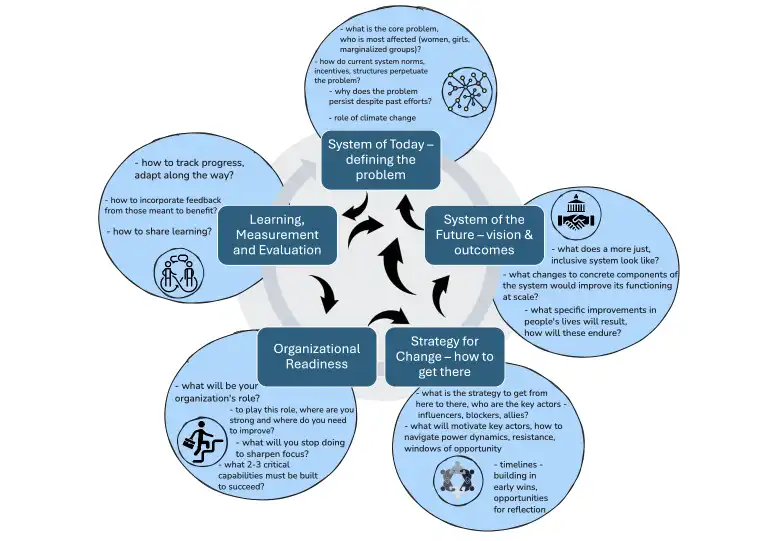
The methodology generates a strategic approach to the problem, that must then be continually adapted and iterated during implementation. Unlike other strategy consultancies, Kiungo stands ready to walk with partners throughout this process – from design to doing so that analysis, ideas and approaches are regularly refined and redefined.
Often, the process makes visible something many organisations already sense but struggle to work on: that no single actor can shift the problem alone. When this happens, Kiungo can also support partners to build a collective impact initiative.
While our approach encourages partners to orient around and engage public systems, we also recognise that context matters. In some moments, working closely with government is not realistic, safe, or productive. We will help outline approaches that work for all of our partners while staying faithful to our commitment to address problems at scale, sustainably.
We further understand that the non-profit sector in particular, is beset with legitimate anxieties around resources, especially given recent cuts. We will support partners to review their fundraising approaches for newly developed strategies including making the most of philanthropic resource injections.
For Kiungo, local legitimacy, networks and knowledge are key. We invest heavily in knowing what’s happening around us: who is already acting, what incentives shape behaviour, what holds problems in place, and what might realistically help them shift.
Where helpful, we leverage our networks in Tanzania and Uganda to connect partners to trusted experts to support specific aspects of their work and to researchers, practitioners, and former government officials who bring insider perspectives on how public systems function and how decisions are made.