
OUR OFFER
Designing Strategies for Systems,
Scale, and Sustainability
Many social change efforts do not dream big enough.
Often, in NGOs or civic organisations, we struggle to even imagine solving problems completely, at the scale of the need, in a way that lasts. We limit ourselves to improvement not transformation; temporary progress for some instead of lasting change for all.
But scale is a moral question. If 100 people are being tortured, can we be satisfied with helping 10 of them to experience slightly less harmful torture?
Scale: go big
Scale is often confused with growth: more programs, staff, geographies. But we need to move beyond the idea of working at scale to think about impact at scale
Inspired by our friends at the Societal Thinking and the Center for Exponential Change, Kiungo believes scale is about distributing problem-solving capacity rather than solutions.
Practically this is often realized through concerted, collaborative effort across many actors – public, private, civic. Co-creating solutions instead of trying to sell them to others results in better solutions and wider ownership. Working at scale means thinking about who does and who pays for the solution. The answer is rarely the preserve of any one person or entity – no matter how competent, well-resourced or well-intentioned.
Sustainability: dig in
For many of us, sustainability means continued funding – larger grants, more donors, or new private-sector resources. Sometimes it is framed as building organisations strong enough to survive indefinitely.
But sustainability should force us to ask how social change endures:
• How does change stick, rather than depend on individuals, projects, or moments?
• How does progress continue without consuming ever-increasing resources?
This has substantial implications on how organisations view funding, and especially how to make use of large philanthropic injections of cash without being forced to rely on these injections to continue.
Systems: how we live and learn
Successful scale and sustainability largely depend on public systems — the complex interplay of factors and actors that deliver and do public work.
Government sits at the centre of public systems. And yet, most external actors – NGOs, businesses, thinktanks – don’t understand what makes people in government tick. As a result, they often choose to work around, against or in parallel with government.
But the largest gains in human wellbeing over the past fifty years — from life expectancy to education and health outcomes — have come through governments, often working with others.
Society-wide change does not happen or last without the state. Stewards of social change need to understand how public systems work, and how they can be transformed.
Strategy @ Kiungo
To address recurring gaps in social change strategies and approaches, Kiungo uses a systems change strategy making methodology from Co-Impact and JustSystems to support organisations and collectives. We also draw on powerful insights, tools and frameworks around impact at scale from Spring Impact, and the Scaling Community of Practice. Our core areas of focus are the under-addressed factors that can drive or block social change: purpose, alliances and relationships, and learning.
We support partners to clarify:
• the problem they seek to shift,
• how the system currently produces that problem,
• what would need to change for different outcomes to emerge,
• and where influence is realistically possible.
Figure 1: Methodology
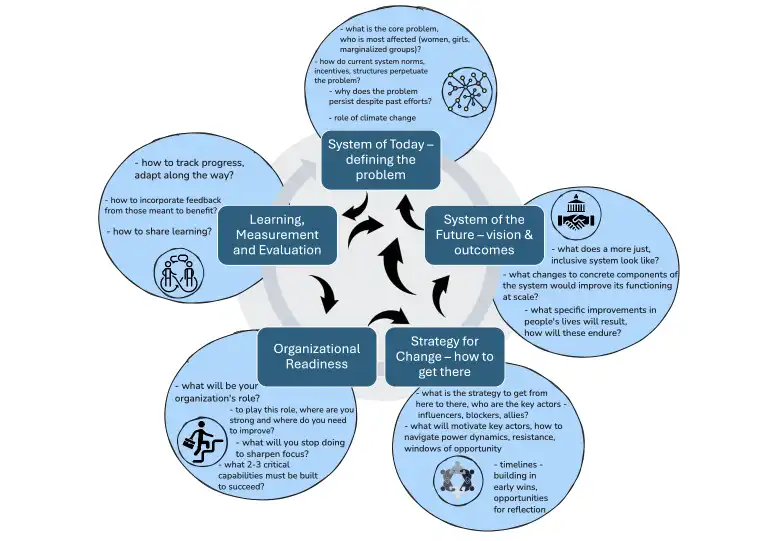
The methodology generates a strategic approach to the problem, that must then be continually adapted and iterated during implementation. Unlike other strategy consultancies, Kiungo stands ready to walk with partners throughout this process – from design to doing so that analysis, ideas and approaches are regularly refined and redefined.
Often, the process makes visible something many organisations already sense but struggle to work on: that no single actor can shift the problem alone. When this happens, Kiungo can also support partners to build a collective impact initiative.
While our approach encourages partners to orient around and engage public systems, we also recognise that context matters. In some moments, working closely with government is not realistic, safe, or productive. We will help outline approaches that work for all of our partners while staying faithful to our commitment to address problems at scale, sustainably.
We further understand that the non-profit sector in particular, is beset with legitimate anxieties around resources, especially given recent cuts. We will support partners to review their fundraising approaches for newly developed strategies including making the most of philanthropic resource injections.
For Kiungo, local legitimacy, networks and knowledge are key. We invest heavily in knowing what’s happening around us: who is already acting, what incentives shape behaviour, what holds problems in place, and what might realistically help them shift.
Where helpful, we leverage our networks in Tanzania and Uganda to connect partners to trusted experts to support specific aspects of their work and to researchers, practitioners, and former government officials who bring insider perspectives on how public systems function and how decisions are made.
Ready to make big change happen together?
Strategic Accompaniment for Implementation and
Organisational Development
Many social change efforts place too much faith in planning and direct too little energy to how they function.
Strategies are written, retreats are held, frameworks are generated. Planning fills calendars and consumes energy — in government and civil society alike. But change happens in the doing not the designing.
Implementation: think while doing
Too often, implementation is treated as execution rather than thinking. As if strategy comes alive in boardrooms, and delivery is about compliance and follow-through.
But implementation is an intellectual engagement. It is not parallel to limbs mindlessly carrying out the orders of the brain that knows best. Those at the frontlines of rolling out plans and strategies confront realities that plans cannot fully anticipate. They adapt design based on how things work in practice, they surface new risks and challenges, and they are closely connected to the people affected by the work. All of these put them in a unique position to know how things should be done.
This means that any plan has to be an iterative document, that changes based on implementation, and particularly the experiences and insights of those doing the delivery. Implementation generates insight that should shape strategy.
When strategy and implementation are separated, we lose opportunities to learn more and do better.
Organisation culture: build what you need
Ambitions around scale, sustainability, and systems change, and a focus on implementation, demand new ways of working. Organisations will most likely need to create space for new views and voices in decisions, to make changes and learn as they go, and to meaningfully track the impact of their work.
Often, this means we are upending traditional hierarchies around who carries expertise, who is responsible for what and what behaviours are rewarded.
Yet many organisations under-invest in their own development — often constrained by donor models, short time horizons, or pressure to prioritise delivery at all costs. But a fragile organisation cannot sustain transformative change.
When the work demands new approaches, piecemeal fixes do not hold. Patching individual capabilities rarely leads to deep or lasting shifts.
Making space: focus on what’s core
Many civic organisations (and government departments) are overwhelmed by the urgent and immediate.
We are incentivised by multiple everyday transactional demands – meetings, staying on top of inboxes, compliance and dealing with the urgent but often unimportant.
The daily pull of now crowds out what matters most. Stepping back from the fray; taking time to think, imagine and connect deeply; and focusing on purpose are critical.
Leaders stewarding transformative change need attention to wellbeing and personal practice. Teams need time to think together, build trust, and engage openly with new ideas — and with disagreement. Yet spaces for collective sense-making are rare. The power of convening and reflection is consistently undervalued.
Accompaniment @ Kiungo
At Kiungo, we provide strategic accompaniment to support implementation and organisational development. We work alongside partners as they put ideas into practice, navigate obstacles, and adapt to what they are learning.
Historically, support beyond design and planning has been deeply under-valued. But, as people seek to do work, they need allies, friends, cheerleaders and constructive critique – both to support changes to organisational culture that unlock their strategy, and to grapple with roadblocks along the way.
Where helpful, we connect partners to trusted specialists — from inclusion to monitoring to financial systems. Kiungo does not claim expertise where others are better placed.
Our accompaniment focuses on two interconnected areas.
Implementation support: we serve as advisors, thought partners, and sounding boards as work unfolds. We help partners reflect, adjust, and make decisions in real time — informed by evidence, experience, and context. We place particular emphasis on learning and adaptation, supporting our partners to generate insights from their everyday work and making those insights actionable so that they can be quickly and effectively built back into program design.
Organisational development: drawing on organisational strengthening approaches from BUILD at the Ford Foundation , Co-Impact and others, we work with partners to clarify the culture they want to build, grounded in values . Together, we explore how those values shape everyday practice from management to measurement.
Organisational culture is created through daily interactions — how policies are interpreted, how rules are applied, how people work together in practice. Iterative implementation likewise depends on learning from all parts of an organisation or collective. For this reason, we build in regular moments of collective reflection. Teams come together; assumptions are revisited, learning is shared, decisions evolve.
Coaching and facilitation are the lynchpins of our support. We unleash organisations’ best versions of themselves so that they can do and deliver with dignity.
Ready to make big change happen together?
Collaboration for Collective Impact
Many changemakers struggle to work together well.
This is especially true when collaboration must cross sectors, institutions, or political divides. We prefer familiar partners, shared language, aligned values.
But the problems we face do not respect these boundaries. Climate breakdown. Inequality. Failing public services. Shrinking civic space. None of these can be solved by single organisations acting alone.
Collaboration: necessary, not optional
Collaboration is often treated as a nice addition — something to try once a strategy is in place, or when funding requires it. In reality, collaboration is frequently the only credible path to impact at scale. No one actor holds all the levers; no one perspective is sufficient; no one institution can move the system alone.
Yet working together is hard. And many collaborative efforts fail — not because collaboration is flawed, but because it is poorly understood and under-supported.
Why collaboration breaks down
At Kiungo, we see three recurring challenges.
1 – Purpose: what are we really here to change?
Too often, shared purpose is vague or overly narrow. “Youth empowerment” means everything and nothing. At the same time, interests and incentives are left unspoken. Very few actors are fully vested in the success of a collective, and many are pulled by competing priorities. Collaboration requires clarity and honesty about interests.
2 – Process: how we work together
We consistently underestimate the human and relational work required to collaborate well. Trust is rushed or ignored. Groups either talk endlessly and stall, or move too quickly without alignment. Good collaboration does not emerge by accident – it is designed and stewarded.
3 – Power: who is in the room
We gravitate toward people like us — those we trust, agree with, or feel comfortable around. But real change often requires working with those we disagree with, compete with, or actively distrust. Sometimes, collaboration means engaging the enemy.
Collectives @ Kiungo
At Kiungo, we are deeply invested in building effective collectives.
Our experience tells us that collaboration is one of the most under-developed and under-resourced capacities in social change efforts — despite being one of the most critical. We support organisations through the early and often neglected stages of collective impact work:
Identify the right actors
Not just who you know, but who has influence over the change you seek — including actors outside the usual circles.
Build relationships before convening
Trust does not begin in workshops. It is built through careful, often quiet work long before people gather in a room. This work takes time. And it cannot be rushed.
Clarify leadership and roles
Who invites? Who convenes? Who guides? Effective collectives require people with the standing to bring diverse actors together, and the skill to facilitate across difference toward action.
This work often emerges naturally from strategy and implementation processes. In some cases, it becomes the strategy.
Backbone leadership: holding the work
Where welcomed by the broader group, Kiungo can play an ongoing role in supporting collectives. In particular, we can act as a backbone leader – an enabling role focused on holding the collaboration together and keeping it oriented toward impact.
Backbone leadership is stewardship not control. Backbone leaders support shared learning, sustain relationships, and help groups navigate tension, drift, and fatigue. They keep attention on purpose and progress, even when interests diverge. Aligning diverse actors — with different incentives, power, and agendas — requires a different kind of leadership and this is the role that Kiungo is energised and enthused to play for collective efforts.
Where Kiungo cannot directly support the collective as the backbone leader, we are also able to provide support, thought partnership and tools to the leader selected.